The The recruitment pattern and inter-calving interval of the reintroduced greater one-horned rhinoceros (Rhinoceros unicornis) population in Manas National Park, Assam, India
DOI:
https://doi.org/10.69649/pachyderm.v66i.1322Abstract
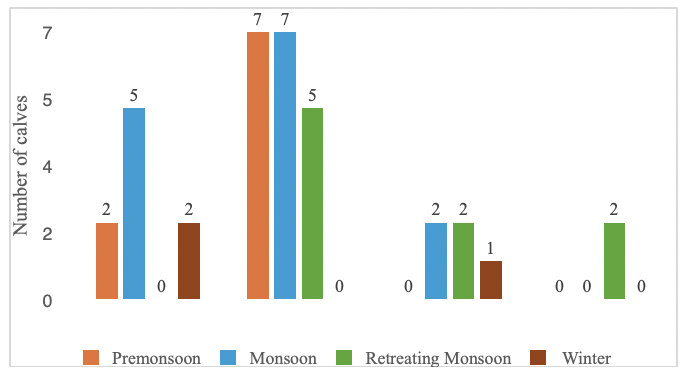
This study examines the reproductive performance and inter-calving intervals (ICI) of reintroduced greater one-horned rhinoceros (Rhinoceros unicornis) in Manas National Park, India, from 2012 to 2021. The Park's rhino population was previously wiped out due to poaching but has been re-established through the wild-to-wild translocations under the Indian Rhino Vision 2020 (IRV2020) and rhino rehabilitation programmes. Our monitoring and analysis reveal that translocated and rehabilitated rhinos have adapted progressively to their new environment, with 35 calves born during the study period (2012–2021). We observed distinct conception patterns among translocated rhinos that conceived before translocation compared with those that conceived after their release in Manas NP. The average ICI for rehabilitated rhinos was 2.12 to 4.41 years, while for translocated rhinos it was 1.99 to 6.30 years. Study findings indicate that the average age at first calving for the first generation (F1) was 5.65 years. Our findings indicate that rehabilitated rhinos tend to calve near human presence, close to the anti-poaching camps, while translocated rhinos preferred more isolated areas. We also observed seasonal calving patterns, with most births occurring during the monsoon (May–September) season. The study highlights the importance of effective monitoring, anti-poaching measures, transboundary collaboration, habitat management, and community support for the long-term conservation success of the rhino population in Manas NP. Our research contributes to the understanding of rhino reproductive biology in re-establishing populations and informs conservation strategies for this threatened species.
Downloads
Published
How to Cite
Issue
Section
License
Copyright (c) 2025 Deba Kumar Dutta

This work is licensed under a Creative Commons Attribution-NonCommercial 4.0 International License.