Assessing crop palatability as a tool to mitigate elephant crop-raiding: trade-offs and strategies for subsistence farmers in Sagalla, Kenya
DOI:
https://doi.org/10.69649/pachyderm.v66i.1325Abstract
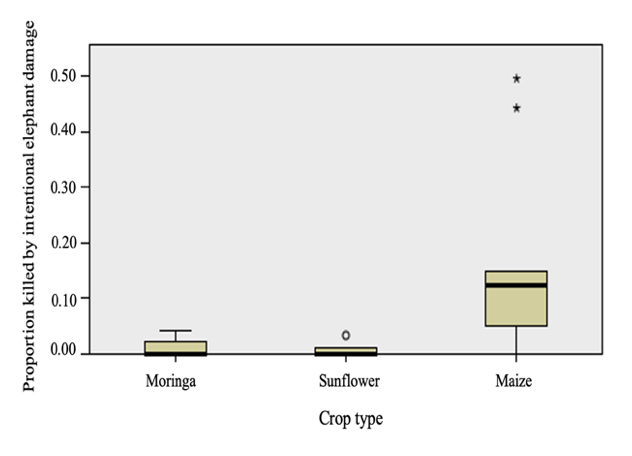
Enabling the coexistence of elephants and humans is challenging, especially in areas where elephants venture outside protected areas to raid crops. This creates human elephant conflict (HEC), jeopardizing farmers' food production and economic security, impeding elephant conservation efforts and threatening the safety of both humans and elephants. Understanding the palatability of different crops to elephants is fundamental for mitigating raiding behaviour, however species-specific crop palatability remains poorly understood. In this study, we conducted on-site farm experiments and semi-structured interviews to evaluate the suitability and palatability of moringa (Moringa oleifera) and sunflowers (Helianthus sp.) to African savannah elephants (Loxodonta africana) in comparison to the highly palatable and locally valued maize (Zea mays). We established 30 experimental plots of the three crops across ten farms in Lower Sagalla, a community adjacent to Tsavo East National Park that frequently experiences elephant crop raiding. We assessed elephant crop palatability through foraging observations and evaluated agronomic suitability using germination and survival rates. Our findings revealed that farmers were divided in their opinions regarding the palatability of moringa to elephants; however there was a consensus that sunflowers were non-palatable to them. Our experiments confirmed that both crops were significantly less palatable to elephants than maize. We conclude that cultivating non-palatable crops represents a promising strategy for reducing elephant crop raiding and diversifying livelihoods in Lower Sagalla. Nevertheless, the success of this approach as conservation and livelihood tools depends on favourable climatic conditions, and agricultural, economic, and cultural contexts, which are highly integrated and dynamic. Additional institutional support through agricultural extension services and market development is also necessary for effective implementation.
Downloads
Published
How to Cite
Issue
Section
License
Copyright (c) 2025 Sophia Weinmann, Kennedy L Leneuyia, Lucy E King, Jill M Belsky

This work is licensed under a Creative Commons Attribution-NonCommercial 4.0 International License.