Advancing black rhino conservation in Kenya: milestones and the strategic outlook for sustaining population recovery
DOI:
https://doi.org/10.69649/pachyderm.v66i.1334Abstract
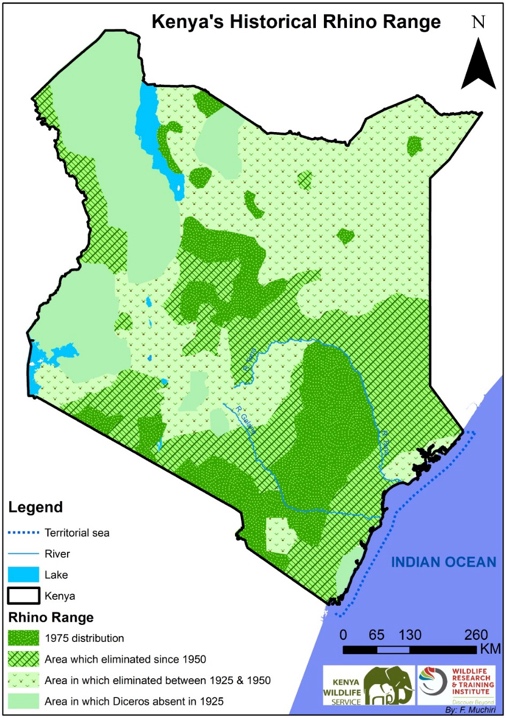
The black rhinoceros (Diceros bicornis) experienced precipitous declines across Africa during the 1970s and 1980s, primarily driven by poaching. The decline was particularly severe for the eastern subspecies (D. b. michaeli). Kenya’s population, which once supported a significant proportion of the species, declined from approximately 20,000 to 370 individuals by 1989, at the time that the Kenya Wildlife Service (KWS) was established. Over the last three decades, considerable effort and resources have been deployed, and an enabling policy and legislative framework have been enacted to recover rhino populations. As a result, the declining trend has been reversed, and the number of indigenous black rhinos is increasing. Remarkable progress has been achieved through strategic interventions and population recovery initiatives, with Kenya’s black rhinos reaching a confirmed total of 1,059 individuals in 2024—marking a historic milestone. We document Kenya’s rhino conservation progression, including the current population status, challenges and future strategies aimed at supporting the long-term vision of achieving 2,000 individuals, thereby securing the future of D. b. michaeli.
Downloads
Published
How to Cite
Issue
Section
License
Copyright (c) 2025 Cedric Khayale, Erustus Kanga, Patrick Omondi, Linus Kariuki, Rob Brett, Timothy Oloo, Martin Mulama, Benson Okita-Ouma, Jamie Gaymer, Raj Amin

This work is licensed under a Creative Commons Attribution-NonCommercial 4.0 International License.